Unlike the unusual, the classic seldom invites us to question it. In the world of jewellery, the floral brooch is such a classic: a design so universally flattering and of such timeless, unoffending beauty that we would barely consider it to tell many tales beyond its decorative value, save perhaps for a romantic dimension added by the language of flowers. And yet, to regard beautiful things as inherently frivolous or meaningless is not merely reductive but downright wrong.
Indeed, the brooch we are about to consider tells many tales: of nostalgia in the face of rapid social shifts, of the embrace of new luxuries, the communication of influence, and even the anxieties of capitalism. As such, the brooch allows us to glimpse a chapter of history – one must only know how to read it. Let us attempt, in this article, just that.
I. Design
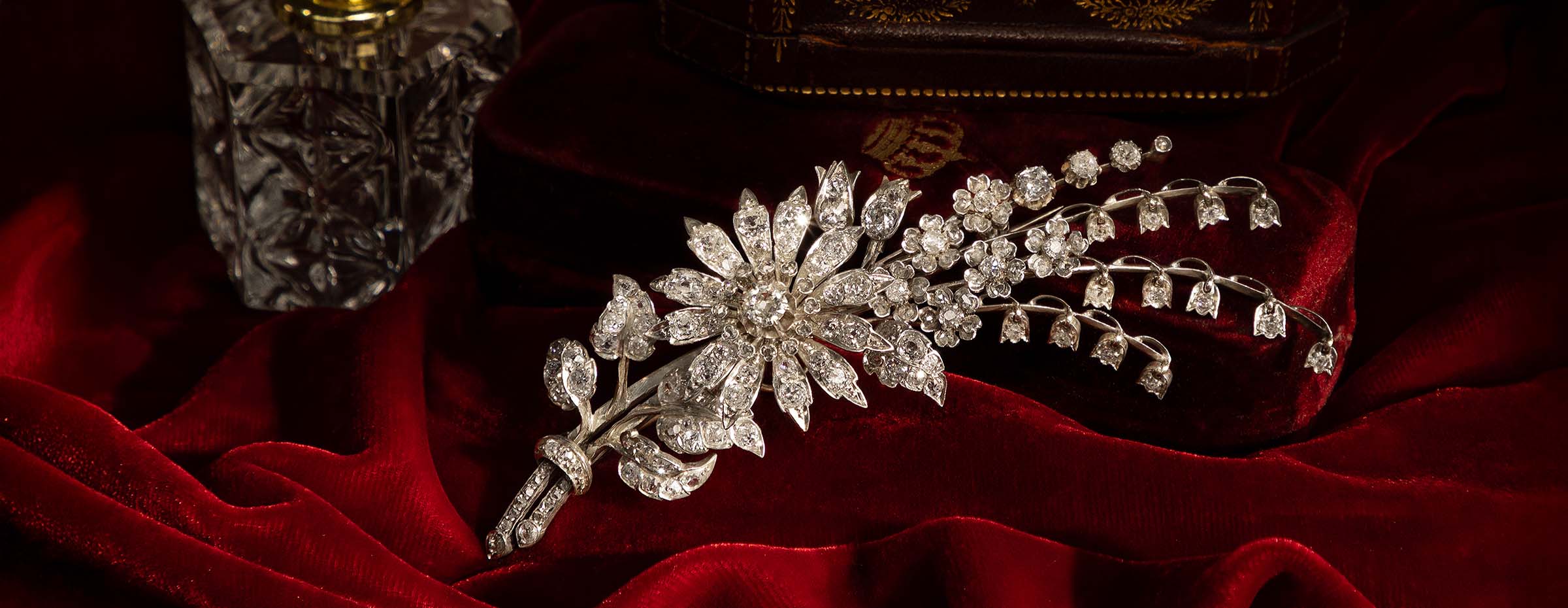
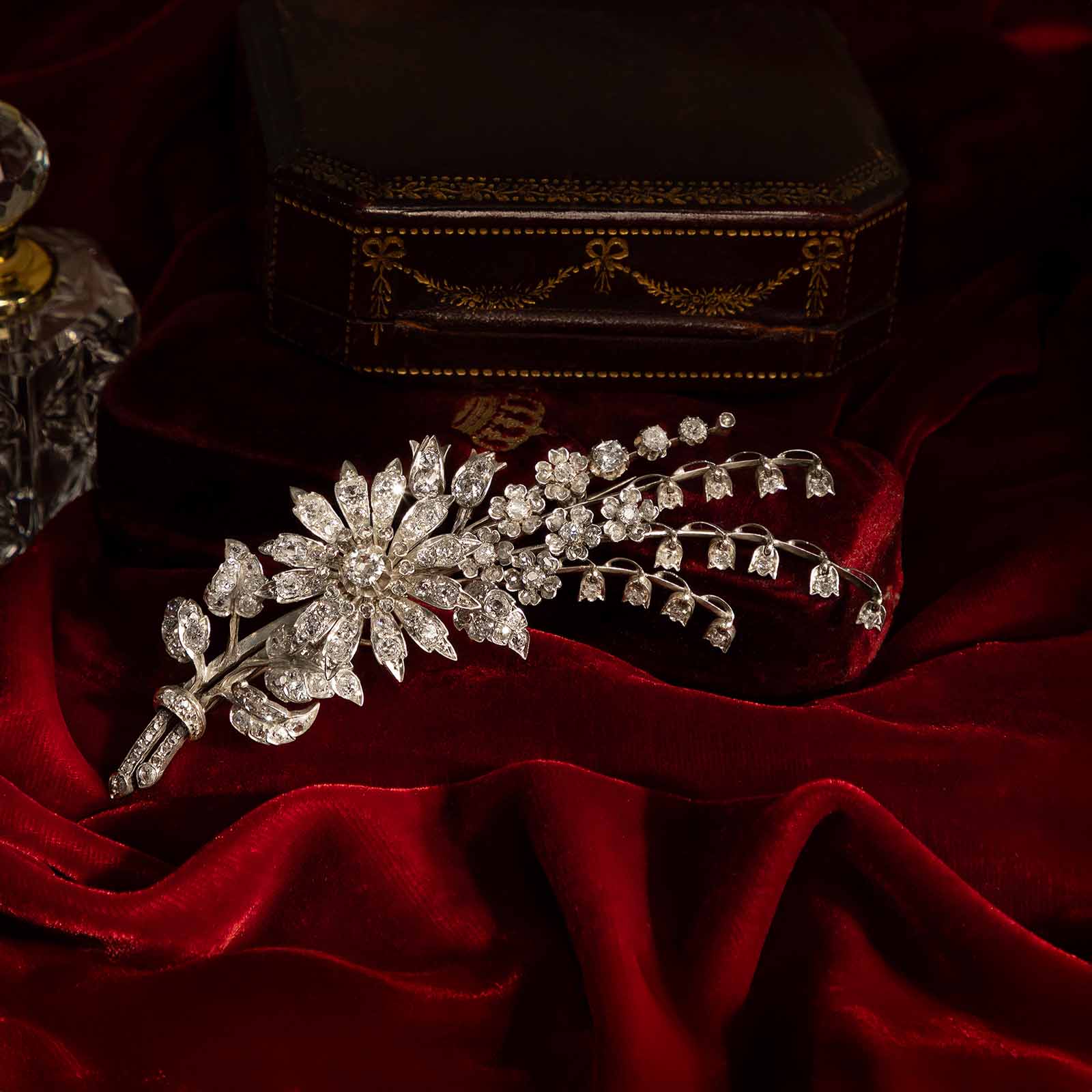
A large floral spray brooch with diamonds in silver on gold, c. 1880
The brooch in question is modelled as a naturalistic bouquet of flowers. At its centre glistens the head of a pointy-petalled flower, a dahlia. Two small rose buds rise behind it. Little forget-me-not and lily-of-the-valley blossoms elongate the composition, tied with a ribbon at the base.
The observant beholder will recognise this design as being deeply rooted in the eighteenth century, particularly the third quarter with its penchant for light-hearted elegance and motifs derived from the flora. Designs for similar compositions, windswept floral bouquets tied with ribbons, come from Rococo-period France, the seat of the ancien régime whose courtly splendour once inspired all of genteel Europe. These were conceived as aigrettes, ornaments for the hair. Extant examples survive in notable collections, for instance an Italian and a British aigrette in the British Museum, or a Portuguese example in the V&A.
Design for a floral jewel from the reign of Louis XVI. From: Émile Reiber, L'Art pour tous: Encyclopédie de l’art industriel et décoratif, 18 (1879), p. 1784
Our brooch was made with these pieces in mind, but more than a century later, around 1880. For one thing, the craftsmanship and diamond cuts alert us to this fact. For another, the design language and execution are sharper, more naturalistic than its eighteenth-century inspirations.
All throughout the 1880s, diamond brooches of this design were popular among the elegant and affluent society of the Western world. The 1880 edition of Martin Gerlach’s Die Perle, a Viennese periodical compiling contemporary jewellery designs, depicts several such floral sprays. Still in 1888, the American Manufacturing Jeweler reported of Parisian fashions that ‘[d]iamond sprays keep to the large flower patterns, full-blown roses, poppies, iris, with their branches of leaves set with brilliants being particular favorites.’1
A plate of floral jewellery designs, 1762. From: Pouget Fils, Traité des pierres précieuses et de la manière de les employer en parure (Paris, 1762), pl. 4
But what caused a revival of this design, and why in the 1880s? Of course, the entire nineteenth century was famously a time of revivals in art and design. This fascination with past eras owed little to a lack of innovations, but rather a lot to an abundance of them. After the French Revolution, the old world order had increasingly begun to be questioned. The once-unshakeable faith in age-old institutions from monarchy to the church was crumbling; by the end of the century, atheism, socialism, even anarchism had come to be discussed by an intellectual avant-garde.
But even for those less able or willing to partake in discussions of novel concepts, life had been rapidly altered by industrialisation, science, and technology. In the face of such profound changes, the past appeared seductive in its stagnant comfort; after all, what had already happened could not change. Furthermore, the different eras of history provided a sense of guidance and even identity. Still in 1910, a German jewellery columnist lamented:
Anonymous after L. van der Cruycen, design for an aigrette (left) from an album of jewellery designs, Paris, c. 1770. Met Museum, 32.129(6)
A style to suit to our modern spirit has, despite our best efforts, not yet been found, and so the taste of the consumer, which after all cannot do without authoritative and convincing guidance, leans more strongly on the stylistic tendencies of past epochs, perhaps seeking to increase or even multiply their effects by comparison against the emptiness of the present, and finding itself more at home in the old, the familiar, a feeling which is given a practical expression through taste.2
From today’s perspective, of course, it was precisely the appropriation of historical forms which constituted the spirit of those times, as we will see. Beyond staying current at conservative courts, the Rococo style experienced not one, but several significant revivals in nineteenth century Europe – each revival fuelled by its own reasoning. And so, what could a brooch in the courtly style of the eighteenth century communicate in the 1880s?
Jewellery designs from Martin Gerlach’s Die Perle, 1880, vol. 2, pl. 24
The answer is as brief as it is unsurprising: power. In a costly diamond brooch, this may not surprise. However, the actual significance lies in the shifting of power – from the aristocrats of the ancien régime to a new kind of ruling class: the rising bourgeoisie, who had gained wealth, education and influence through industrialism and the changing political climate.
To aristocrats, historical styles meant continuity and, from an aesthetic point of view, that newly purchased pieces matched with heirloom jewels. Yet for women who did not possess such heirlooms – who might even be of the first generation to live in wealth – to wear brooches of the same splendour as the aristocrats with whom they brushed shoulders at the opera signified their social rise.
Beyond being an example of ‘trickle-down’ economics, the adoption of designs which had once been reserved for queens, countesses and courtiers exemplifies the shift in sociopolitical influence which marked the nineteenth century – a symbolism further enhanced by the use of diamonds.
II. Materials
Adolph von Menzel, The Dinner at the Ball, oil on canvas, 1878. Alte Nationalgalerie, Berlin, A I 902
Picture a ballroom, circa 1880. It is a seductive image that comes to our minds easily: in the warm glow of the gaslights, hundreds upon hundreds of diamonds glitter on fine duchesse silk, in opulent curls and on beribboned necks. If we imagine the same room a mere two decades before, we might be tempted to picture just the same. Yet in truth, the predominance of diamonds was, on this scale, a novelty and unique trait of the jewellery culture of the last third of the nineteenth century.
Three simultaneous developments had made it possible: firstly, the discovery of the vast diamond deposits in South Africa at the end of the 1860s which soon led to a drastic decrease in diamond prices. ‘Diamonds are very cheap just now, or at least the dealers say so, though to unaccustomed ears the sums asked for them sound something fabulous’, one could read as early as 1873.3 By 1888, famous American mineralogist George Kunz noted that, owing to this development, diamonds had been worn ‘promiscuously’ in recent years.4
Diamond jewels of the Belle Époque, c. 1890-1900
This leads us to the second and third development: the decrease in diamond prices worked in unison with machine production and the increase of bourgeois wealth to appeal to a new and wider class of buyers.
Of the Fashions in Jewellery, a British periodical wrote in 1887: “These productions are in response to a demand that is constantly increasing as the country grows in wealth, and the number of persons who can afford to gratify their longings for the beautiful multiplies with such rapidity as it does in this country.”5 In other nations renowned for their jewellery industries during this period, the situation was no different. France’s economy was growing, America was in its gilded age, and Germany, a recently united empire, was experiencing a rapid upswing.
But it was not simply a “longing for the beautiful” that led people to reach for diamonds. Just like classic jewellery designs such as the floral spray, so diamonds had once been the prerogative of a lucky few, those born into the aristocracy. Now, they adorned not only those whose birthright they were – but anyone who could afford them.
A large floral spray brooch with diamonds in silver on gold, c. 1880
III. Function
A diamond aigrette worn in the hair. Detail from Daniel Klein, Marie-Thérèse-Raphaëlle de Bourbon, infante d'Espagne, Dauphine de France, en 1745, oil on canvas, c. 1745. Versailles, MV4451
Although our floral spray deliberately references eighteenth-century jewels in form and materiality, its function differs slightly from this historic inspiration. For while eighteenth-century floral sprays were conceived as aigrettes for the hair, our piece is a brooch. Certainly, it can still be worn in the hair, and perhaps even was; women of the Belle Époque often took creative license with their jewels. Moreover, our brooch can be taken apart into three separate diamond elements, of which the large flower head and the spray of blossoms could once be worn separately, likely as smaller brooches or hair pins. As with so many convertible pieces, the additional fittings have been lost to later generations.
The convertible nature of the piece is characteristic of grand late nineteenth-century diamond jewels. It reflects the lavish cost associated with such purchases, and thus a certain lingering economic cautiousness, for it meant that the piece could be worn more often.
The diamond brooch, disassembled
Not only was this practical, its wearer could also avoid repetition. Fear of the latter was increased by social pressure: events which warranted fine jewels were widely reported on in newspapers and fashion magazines, and such reports often lingered on women’s wardrobe choices, down to the detail of their jewellery.
These fashion magazines and columns, whose number had been consistently growing since the late eighteenth century, were themselves a symptom of the times. Industrialisation and mass production had made many people more affluent, and jewellery more affordable, but they had also spurred on the currents of fashion and thus increased the difficulty of pleasing the capricious dame. Although gowns and jewels could be purchased at much lower prices than decades before, this had to be done more often to stay up to date: capitalism, a term coined in the middle of the century in response to industrialisation, was in full effect.
Gustave Jean Jacquet, Costume Ball (Minuet), detail, oil on canvas, 1880. National Museum of Warsaw, M.Ob.1221
In fact, already by the 1890s, the large floral spray brooches began to be considered demodé by the fashion-forward, as other patterns came to the fore. In 1892, one fashion columnist noted: ‘Everything is subject to constant change, and so, almost unnoticed, the greatest changes in the production of jewellery are taking place before our very eyes … the once much-admired brilliant-set floral sprays are no longer modern at all.’6 Of course, this would not keep those of a more conservative taste from continuing to wear theirs.
But what was a particularly fashion-conscious woman left to do with her costly yet somewhat unfashionable jewel? She might, for instance, slip into the guise of a Rococo lady at one of the many popular costume balls: a popular manual advised its readers to wear a silver cloth gown and ‘diamond aigrette’ to dress as a Dauphine of Versailles.7 Or, arguably more reasonable than to keep it for playing dress up, she might have the diamonds re-set into pieces in a more modern style, as was quite common: ‘a true London society lady has to pay just as many visits to her jeweller as to her milliner. One day she will buy a new piece, another day she will have gemstones re-set because the fashion is changing’, noted the German Bazar in 1896.8
Luckily, our brooch has evaded this latter fate, and remains in its original form as a witness of the profound shifts that marked nineteenth-century Western culture.
1The Saunterer, ‘Points from Paris’, The Manufacturing Jeweler, 5 (1888), p. 82-84, p. 82.
2l, ‘Das antike Genre’, Deutsche Goldschmiede-Zeitung, 13 (1910), p. 310-12 (p. 310). This and footnotes 6 and 8 are the author's own translation.
3[Anon.], ‘The Fashion of Jewels’, Scribner’s Monthly. An Illustrated Magazine for the People, 6 (1873), p. 499.
4George F. Kunz, ‘On Diamonds’, The Watchmaker, Jeweller and Silversmith, 1 May 1888, p. 164-65 (p. 164).
5[Anon.], ‘Fashions in Jewellery’, The Watchmaker, Jeweller and Silversmith, 1 October 1887, p. 60.
6Fr. Fr., ‘Neue Schmucksachen’, Der Bazar, 38 (1892), p. 474.
7Ardern Holt, Fancy Dresses Described, or What to Wear at Fancy Balls (Debenham & Freeberry, 1887), p. 66.
8Annie Bock, ‘Einkäufe der Londonerin und der Petersburgerin’, Der Bazar, 42 (1896), p. 144-45 (p. 144).
Lea Felicitas Döding
As an art historian, I am primarily interested in the material culture of jewellery. Who would have worn a piece, when and why? What was the cultural significance of certain gemstones and jewellery designs? These are the questions I attempt to solve for the Hofer Magazine, and which often lead me into the depths of jewellery history.